by Agostina Ferrentino, Clara Rius, and Ramón Torrents
Introduction: Space for music
The hospital is one of the most acoustically demanding environments that exist. Medical equipment, alarms, conversations and continuous activity generate noise levels that affect both rest and the emotional state of patients and staff. For decades, healthcare design has focused on minimising this impact through sound insulation and acoustic absorption solutions. However, recent research suggests a change in approach: it is not only about reducing noise, but also about intentionally incorporating sound as part of the therapeutic process.
With this starting point, a systematic review of the scientific literature on the use of music therapy in hospital settings was carried out and published in the last quarter of 2024. Using the PubMed database and the specialised repository of the Center for Health Design, 68 studies published between 2014 and 2024 were identified and analysed. The underlying question was not only clinical: the aim was to explore what implications this evidence has for the architectural design of hospitals.
Measurable clinical effects
Out of 68 references, 95.52% reported statistically significant benefits. The remaining 4.47% also indicated improvements, although without reaching statistical significance.
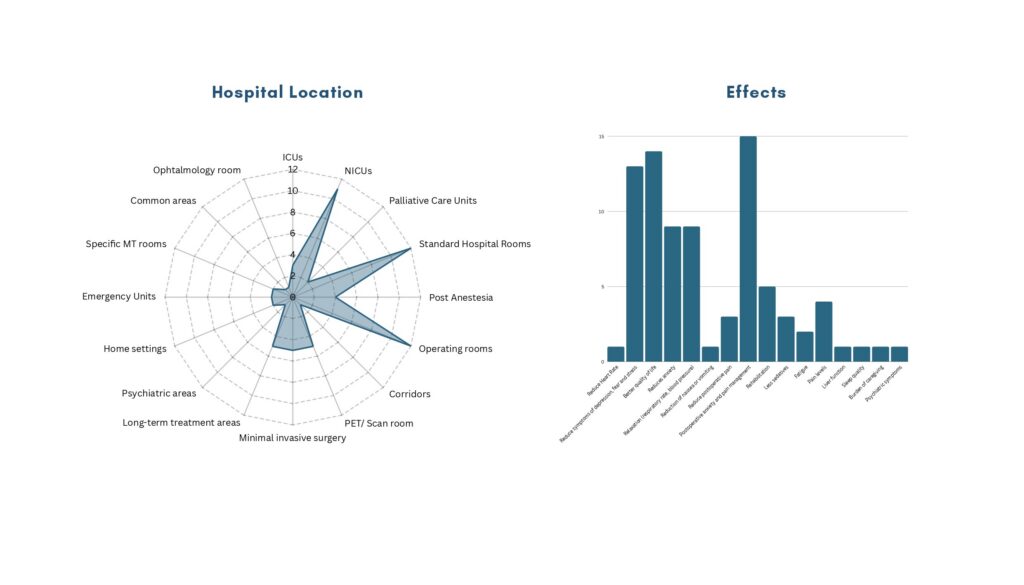
Among those reporting statistically significant benefits, the evidence shows that music induces physiological responses associated with relaxation, such as reduced heart rate, blood pressure and respiratory rate. These effects are especially relevant in intensive care units, surgical areas and standard hospital wards, where anxiety and stress can affect recovery.
In surgical contexts, music therapy reduces pre-operative anxiety, improves haemodynamic stability and decreases the perception of pain after the intervention. In some procedures, it has even been associated with a reduced need for sedatives. In long-term treatments, such as oncology, dialysis or palliative care, patients exposed to music report improved mood, less fatigue and a higher perceived quality of life.
The benefits also extend to highly sensitive areas such as neonatal units, where music helps stabilise vital signs and supports the neurological development of premature newborns. In patients with neurological disorders or brain injury, improvements have been observed in cognitive function, language and functional autonomy.
In addition, the positive impact is not limited to patients. Healthcare professionals exposed to music interventions report a better perception of the acoustic environment, while relatives and caregivers experience reduced emotional stress. (Figure1 and 2)
A flexible and adaptable intervention
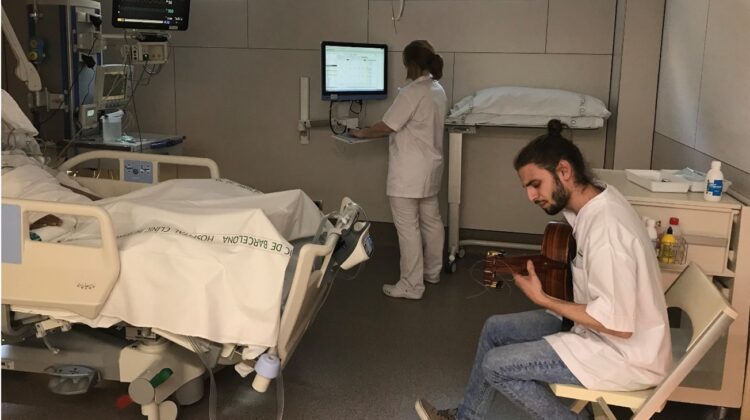
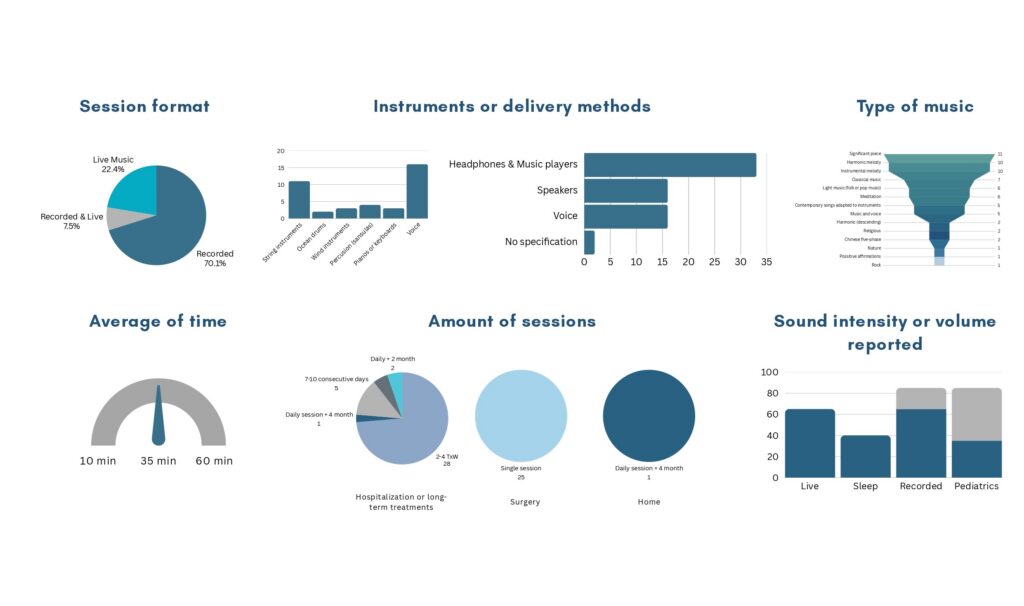
From a technical point of view, music therapy is highly versatile. Most interventions use recorded music played through headphones or loudspeakers, although live sessions with instruments or voice are also common. Sessions usually last between 10 and 60 minutes, and in many cases a single session is enough to produce positive effects.
The acoustic characteristics of the music influence its effectiveness. Studies agree that slow, regular rhythms, simple melodies and soft dynamics support relaxation. However, personalisation is a key factor: music chosen by the patient often enhances the therapeutic effect. (Figure 2)
Regulatory considerations
This integration must be understood within a regulatory framework. Current regulations — the Spanish Noise Law (Law 37/2003) and the Basic Document DB-HR for Protection against Noise of the Technical Building Code (CTE) — establish the permissible sound levels. This means that any sound intervention must be carefully designed to avoid interference or unintended negative effects.
In this context, architecture and acoustic engineering play a fundamental role. The quality of sound insulation between spaces, the control of reverberation and the reduction of background noise are essential conditions for music to be perceived clearly and comfortably. Without these conditions, its therapeutic potential is significantly reduced.
Implications for architectural design
The available evidence suggests that music therapy can be integrated into hospital infrastructure through specific design strategies. These include the incorporation of sound systems adapted for clinical use, capable of adjusting volume and content to individual needs. Rooms with better insulation allow greater control of the acoustic environment, supporting both rest and therapeutic interventions.
In addition, the creation of spaces dedicated to music therapy provides an appropriate setting for active interventions, including the direct participation of patients, relatives and therapists. At a broader scale, the design of the hospital soundscape can help transform the overall perception of the environment, reducing stress and improving the user experience.
Towards better Healthcare Architecture
Hospital architecture has evolved significantly in areas such as natural light, orientation and contact with nature. The acoustic dimension, however, has remained mainly focused on noise control. Current scientific evidence shows that sound, when properly designed, can become a therapeutic resource with real effects on health.
Integrating music therapy into hospital design does not simply mean adding loudspeakers or scheduling musical interventions, but rethinking the acoustic environment as an active part of the healing process. This interdisciplinary approach opens new opportunities for architects, engineers, healthcare professionals and therapists, contributing to the development of hospitals that are more effective, more comfortable and truly centred on human wellbeing.
Would you like to explore this study in more detail?
You can access the full study by clicking here.
………………………………………………………………………………………………………………………………………………………………………………………………………………………………………………………..
Agostina Ferrentino; Architect – Head of Research Department – Ahead Research for Architecture
LinkedIn: https://www.linkedin.com/in/aferrentino/
Clara Rius; Architect – Director – Ahead Research for Architecture
LinkedIn: https://www.linkedin.com/in/clara-rius-aheadbcn/
Ramón Torrents; Architect – Director – Ahead Research for Architecture