
At BNAM 2026 – “Room Acoustics – Offices, Hospitals, Schools, Restaurants”
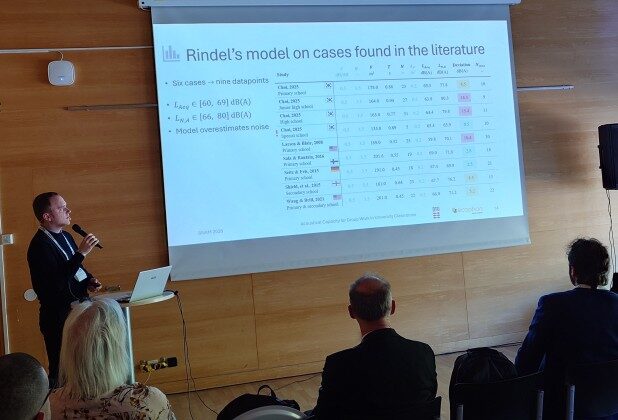
Oliver Bonde’s presentation “Acoustical Capacity for Group Work in University Classrooms” was first up in the session named “Room Acoustics – Offices, Hospitals, School, Restaurants”, chaired by Peter Svensson and Ayca Sentop Dumen.
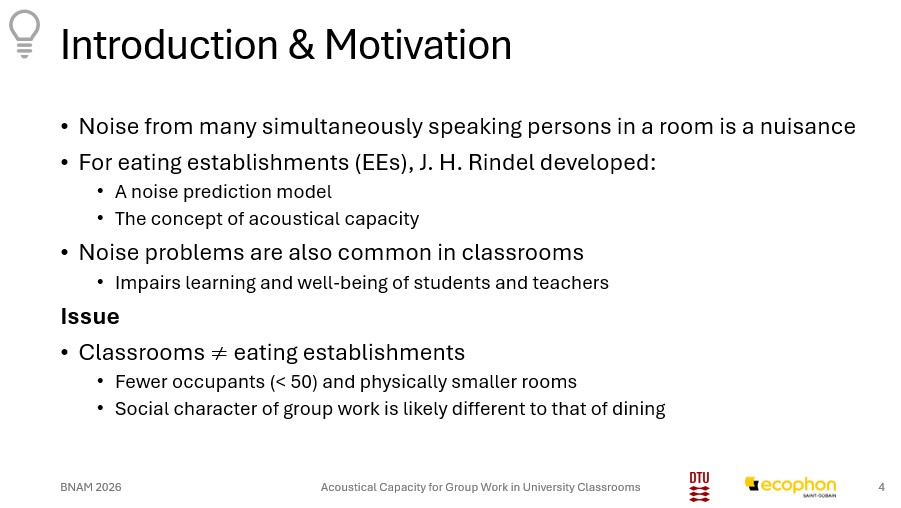
Background and based on Rindel’s eating establishments
As Oliver explained, the concept of “Acoustical Capacity” is very interesting since the maximum number of people for a room is a measure everybody can understand and relate to. In this case, it would be the number of people who can occupy and have conversations in a space before the sound level becomes so high that it will have a significant negative impact on the ongoing conversations. However, the original work of Rindel was focused on eating establishments only and was only verified for such locations.
Rindel’s previous Acoustical Capacity studies
In his presentation Oliver further explained that the Acoustical Capacity, as defined by Rindel, is based on the acoustical properties of the room, such as reverberation time and volume, as well as two other factors, namely the “group size” and the slope of the Lombard effect. The group size simply describes the ratio between the total number of occupants and the number of simultaneous speakers. The Lombard effect isn’t included in the equation for acoustical capacity N_max, because it cancels out when deriving the equation for N_max. If the occupancy is < N_max, then verbal communication at a distance of 1 m, using a raised/normal (depending on the selected SNR used when calculating N_max) voice, is possible.
If more or less everybody is speaking simultaneously, this number would be close to one, whereas if, on average, only a few of the occupants would be speaking simultaneously, the group size would be much greater. Based on this information, the Acoustical Capacity is estimated.
Applying the previous theory to groupwork in a University classroom
As a Batchelor’s thesis project, Oliver explored the possibility of using the concept of Acoustical Capacity for group work in university classrooms. In his work, Oliver have used a twofold approach. Similar to Rindel, he started out reviewing existing literature, to find examples with relevant acoustic information. Such studies were indeed found, but non of them had any estimates on the two key parameters, the group size and the Lombard slope.
He therefore conducted studies of his own on group work sessions in different rooms at DTU, Technical University of Denmark. In these studies, he estimated the group size by observing the sessions. By using the observed range of group sizes also on the studies found in literature, he could make an estimate of the Lombard slope.
Conclusions
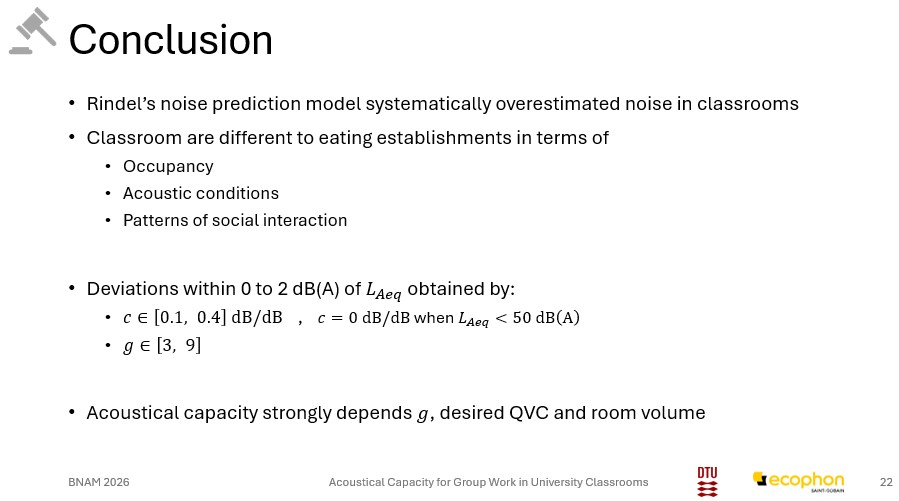
He concluded that, based on his research, for the Acoustical Capacity to be used for group work in university classrooms, at least at DTU, a group size ranging between 3 and 9, and a Lombard slope in a range of 0.1 and 0.4, should be used.
However, Oliver also made it clear that these results are based on limited data, and that more research is required before it can be concluded that the concept of Acoustical Capacity can be adopted to classrooms.
Benefits of valuable feedback
After the presentation, Rindel himself commented the Oliver’s work based on his experience. Comments that Oliver thought were valuable for future work.
Oliver Bonde is a student at DTU (Technical University of Denmark, Copenhagen) and he also expressed his gratitude to co-authors Colin Campbell, Per Hiselius and Cheol Ho Jeong, as well as to Saint-Gobain Ecophon AB for the great collaboration and support – and for having received the opportunity to attend BNAM 2026 in Gothenburg, an excellent learning opportunity and a rewarding experience.