
A guest article written by Evert Ph.J. de Ruiter. Photo courtesy of Ela Fasllija
Acoustical consultant
In 1972, I had just begun my first job as an acoustical consultant, and I was stopped by two policemen for speeding. “Your profession, please?” I answered: “Acoustical consultant”. The policemen looked puzzled, but soon reacted: “You are working in a record shop!” (CD’s had not yet been invented!) The reason for this introduction? Ignorance of acoustics. Confusion about the word “insulation” in building physics is quite common, even with architects and builders. Insulation is a physical phenomenon in the first place, but often it is used to name materials related to the phenomenon.
Now, we must distinguish between thermal insulation and sound insulation. And to complicate things further, many people use the word “soundproofing”, for almost everything that is supposed to improve acoustical conditions; however without defining the circumstances. So it comes down to either increasing the sound insulation of building elements to reduce sound intrusion in a room or increasing the amount of sound absorption to reduce sound levels within a room. This latter is done by adding sound-absorbing materials in the room. In the figure, these different aspects are illustrated in the triangular shape.
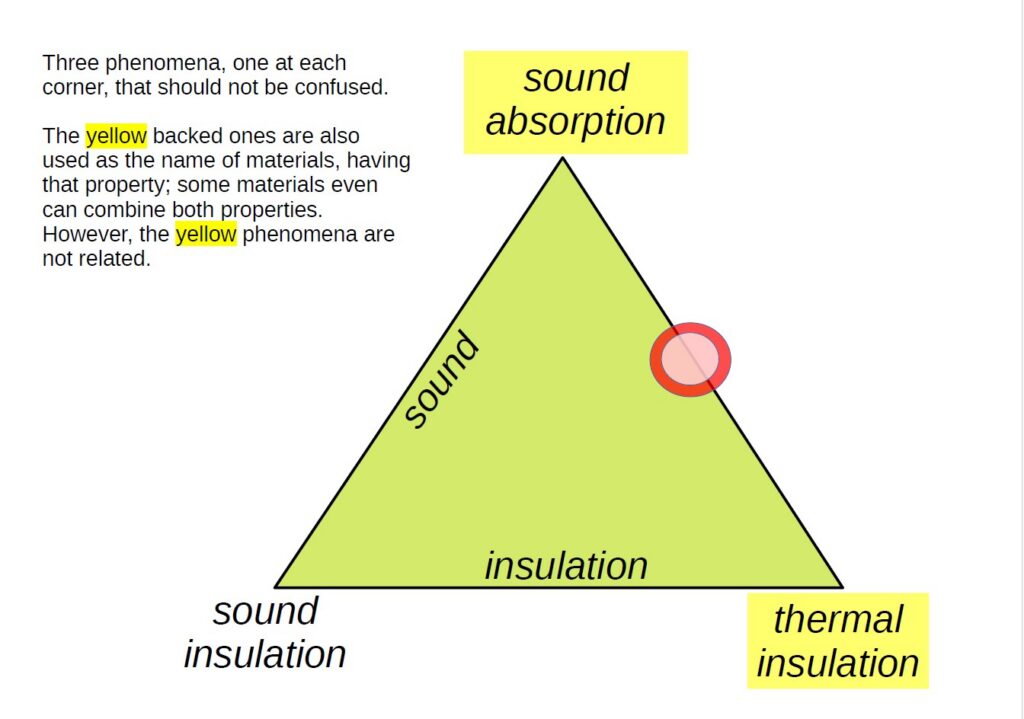
Returning to insulation, both thermal and acoustic insulation express (reduction of) transmission through a building element. In both cases, this regards the transmission of energy: thermal (heat) or acoustic (sound) energy. Sound absorption is quite different: it expresses the (reduction of) reflection of sound.
Metrics of building elements’ properties
Sound insulation is basically a dimensionless number between 0 and 1; between no transmission and full transmission. To fit in the system of logarithmic metrics of sound, the transmission factor t is transformed into the sound insulation R = 10 log (t).[1] The minus sign ensures the resulting R-value being positive.
Heat transmission[2] is given as a heat flow per area unit per unit temperature difference, in degrees; in SI-units usually W/m2K.
Sound absorption again is a dimensionless number between 0 and 1, usually expressed as a percentage between 0 and 100%.
International standards exist to assess the values for building elements in appropriate, certified laboratories.
Anyway, it’s important to distinguish between the properties sound insulation, sound absorption, and thermal insulation, and between the materials that can be used to obtain those properties in a construction.
Noise annoyance

Noise annoyance is not a modern phenomenon. In Roman times, Emperor Nero (31-68) issued decrees interdicting the driving of chariots in the city of Rome during nighttime, because of the noise of the clatter of hoofs and wheels on the uneven road surface. In the city of Pompeii, the tracks in the pavements are silent witnesses to that noise.
In medieval England, under Queen Elisabeth (1533-1603), a law was issued, prohibiting men from beating their housewives … after 10 p.m. Otherwise, the screaming would disturb the neighbours’ night’s rest.
Later, more rules were issued regarding the acceptability of loud noises in cities and around industrial compounds. In the Netherlands, one of the rules was in the Sunday law prohibiting noise that could be heard at distances of 100 m or more. To be judged by a civil servant…
After WW2, electronics opened the options for measuring sound “strength” or loudness, and many other applications like sound amplification, recording and reproduction.
….. and its metrics
In essence, sound is a variation of the pressure in the air, for which our ears are sensitive. The S.I. unit for pressure is N/m2 or Pascal (Pa); it’s also the unit for the amplitude of the variation. That amplitude ranges from almost zero (20 µPa, microPascal) to 20 Pa. This range can be made better manageable by switching to a logarithmic scale, the deciBel scale. Moreover, the human perception of loudness is logarithmic too. The disadvantage of the logarithmic scale is that it requires some knowledge of logarithms. Lack of that knowledge often gives confusion! “If there are two sources making 60 dB each, why isn’t the combination 120 dB?” or almost as incomprehensible for many people: “Why is 45 dB added to 60 dB still no more than 60 dB?” The answer: addition of sounds can only be done in the linear scale (in fact, using the amplitudes squared).
But, in practice, more complications arise: the strength of sound can fluctuate; how to determine a characteristic mean value? To that end the (energy) equivalent sound level has been introduced, essentially it’s the average value, however, calculated in the linear scale.
Next, most sounds don’t exist of just one frequency (pure tone), but of a mix of frequencies (tones) and random variations. The human hearing embraces frequencies from 20 to 20,000 Hz. The highest sensitivity is in the frequency range around 1500 Hz. Not by accident, this matches the character of consonants in human speech: most information is carried by the consonants. But how to weigh the influence of all frequencies in a single number? Several methods have been proposed and practised, but nowadays the A-weighted sound level is the most common. The weighting is usually done through an electronic filter, the A-filter, included in all sound level meters.
Can it be concluded now that two sounds having the same A-weighted equivalent sound level (or LA,eq) are perceived equally annoying? No, unfortunately, we can’t.
Many decades ago, it was recognised that pure tones and rhythmic components are more notable than random sounds. Sounds with pure tones and rhythmic components are thus perceived as more annoying. That’s clear for the different taste of music of your neighbours, but what about your own preferred music? That’s where the aspect of association enters. In many cases, sounds can invoke associations, pleasant, neutral or annoying. These can’t be determined by manipulating the physical data alone. Scientists in the area of psychoacoustics have introduced the notion of soundscape, which focuses on the perception of sounds.
This is a rather recent approach of environmental sound, defined in the international standard ISO 12913-1: 2014, as “the acoustic environment as perceived, experienced, or understood by people in context. It shifts focus from merely measuring noise levels to human perception and context, providing a framework for analysing and managing soundscapes.”
Although the release of Technical Specifications (ISO/TS) in 2018 and 2025 shows progress in the development of the practical application of the soundscape approach — a quite complicated task — it hasn’t reached its final shape yet.
[1], [2] The sound insulation depends on the frequency of the sound; full information requires measurements in (third) octave bands
Evert Ph.J. de Ruiter, PhD
Superdoctoral acoustics researcher
Critical Alarms Lab, Perceptual Intelligence Lab,
Human-Centered Design, Faculty of Industrial Design Engineering, TU Delft
Department of Intensive Care Unit, Erasmus MC