
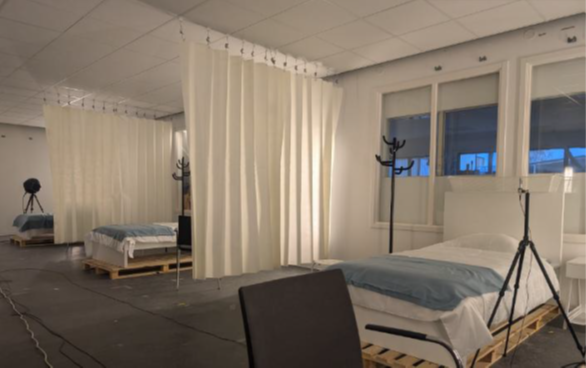
One of the most interesting themes in Session A 16.09: Acoustic Comfort in Hospitals at Forum Acusticum 2026 was the complexity of healthcare acoustics. While reducing noise often seems like an obvious goal, two presentations reminded us that acoustic design rarely solves one problem in isolation. Instead, it involves balancing staff and patient needs, safety, communication, and privacy.
Balancing communication with acoustic treatment
The first presentation, Acoustic Characterization and Noise Assessment in Italian Hospitals, by Veronica Amodeo, presented ongoing research from several Italian healthcare facilities aimed at understanding how hospital noise affects healthcare staff. The researchers found what many healthcare professionals would probably recognise immediately: noise levels were consistently much higher than recommended guidelines, and excessive reverberation amplified the problem. In nursing stations, rehabilitation gyms, and reception areas, conversations, activities, alarms, and medical equipment created challenging acoustic conditions.
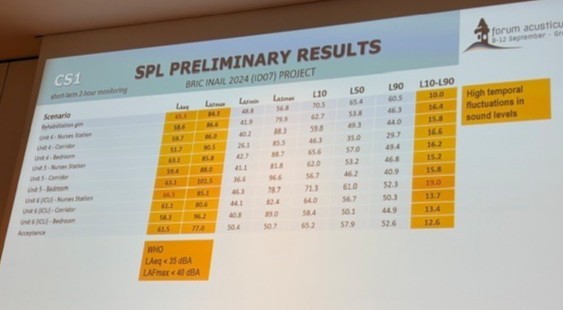
This study had a particularly interesting practical approach. Rather than simply documenting the problem, the team used measurements and simulations to evaluate possible acoustic interventions. Their proposed solutions focused on improving sound absorption through sound-absorbing ceilings and strategically placed wall absorbers designed to meet healthcare hygiene requirements. The simulations showed that these interventions could significantly reduce reverberation and improve the overall acoustic environment.
During the presentation, I was struck by how strongly the discussion centred on staff wellbeing. While patient comfort often dominates hospital acoustics, the researchers highlighted how sustained noise exposure can affect concentration, communication, fatigue, and stress among healthcare workers. The message was clear: improving acoustics is not only about creating calmer spaces but also about supporting staff performance and patient safety.
Design dilemma with opposite needs
Per Hiselius’s presentation, Acoustic Design Recommendations for Intensive Care Units, approached the issue from a different perspective. Using a full-scale ICU mock-up built at Ecophon headquarters in Sweden, researchers investigated how different acoustic treatments influenced communication, noise control and privacy in multi-bed intensive care rooms.
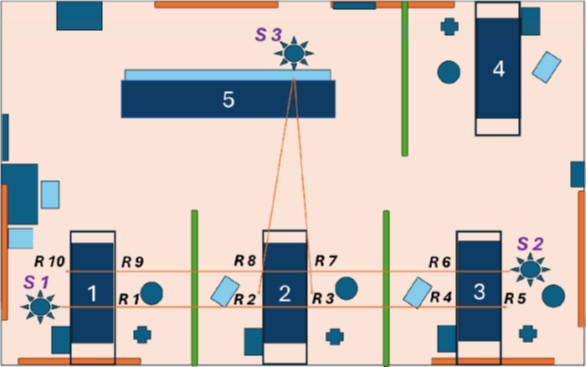
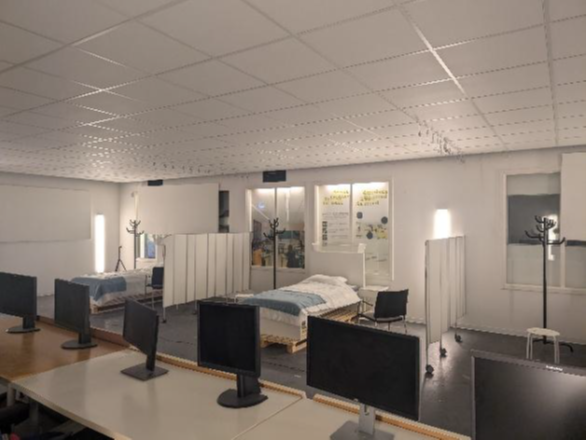
The study highlighted an intriguing design dilemma. On one hand, highly absorptive ceilings and wall treatments improved speech clarity and reduced reverberation, making communication between staff and patients easier and less effortful. On the other hand, improved speech clarity can potentially make conversations easier to overhear, creating challenges for patient privacy.
This apparent conflict became the presentation’s central theme. The researchers evaluated different types of bed partitions, including curtains, reflective hospital screens, and sound-absorbing office-style screens. Their findings demonstrated that excellent communication and good privacy do not necessarily have to be mutually exclusive. Comprehensive acoustic treatment of ceilings and walls improved the general sound environment, while reflective hospital screens helped limit speech transmission between neighbouring beds, thereby supporting confidentiality.
Communication and privacy in one room
Taken together, the two presentations complemented each other remarkably well. The Italian study focused on identifying acoustic problems in real healthcare settings and demonstrated how excessive noise and reverberation can affect healthcare staff. The ICU study then explored in detail how to implement and optimise specific acoustic solutions to address those challenges.
Both presentations reinforced the importance of sound-absorbing ceilings and wall treatments as fundamental elements of healthcare design. However, they also reminded the audience that acoustic success cannot be measured only by lower noise levels or shorter reverberation times. The quality of communication, the ability to concentrate, and the protection of patient privacy must all be considered at the same time.
Veronica Amodeo, Department of Architecture, University of Florence, Italy
Per Hiselius, Research Manager at Saint-Gobain Ecophon, Sweden