
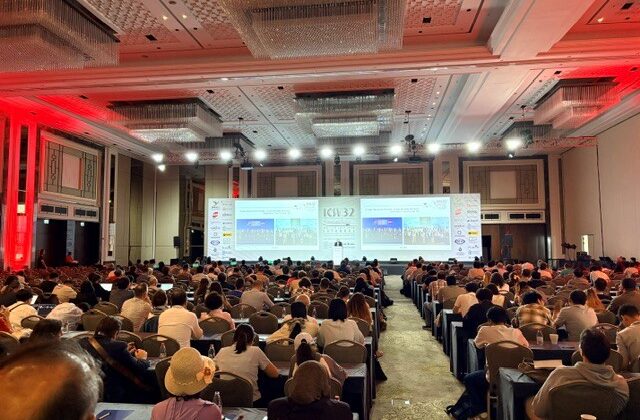
At the recent International Congress on Sound and Vibration (ICSV32) in Istanbul, two presentations stood out for their focus on a common challenge in healthcare: how we can create hospital sound environments that better support communication, concentration, well-being, and performance. While the speakers approached the issue from different angles, both highlighted an important shift in healthcare acoustics—from simply measuring noise towards understanding how people actually experience and function within the sound environment.
Making Acoustics Meaningful in Healthcare Design
In his presentation, Cees van Wezel introduced a participatory workshop method designed to bridge the gap between acoustic expertise and healthcare design practice. Rather than relying solely on technical reports and acoustic specifications, the method engages healthcare staff, managers, architects, and designers in conversations about sound through a structured floorplan-based workshop.
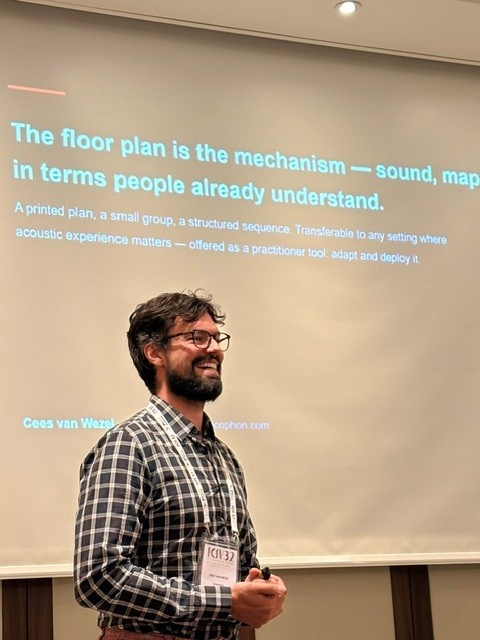
The concept is deceptively simple. Participants gather around a printed floor plan and identify sounds they experience or expect to experience in different locations. Using coloured markers, they classify sounds as positive, negative, or neutral. The discussion then moves towards identifying interventions that could transform problematic areas into places that better support healthcare activities.
According to Van Wezel, the workshop is not intended to replace acoustic consultants. Instead, it helps stakeholders develop a richer understanding of sound, enabling them to ask more informed questions and consider acoustics as an integral design parameter rather than merely a compliance requirement.
One of the most interesting findings from approximately twenty workshops conducted in Dutch healthcare and design settings was the recurring identification of speech as the dominant unwanted sound source. Participants often expected alarms, equipment, or technical noise to be the primary problem. Instead, conversations, handovers, telephone calls, and other forms of speech repeatedly emerged as the sounds that most interfered with concentration and work performance.
Another important observation was that participants consistently recognised the limitations of purely physical solutions. Acoustic treatments, zoning strategies, and spatial redesign can improve conditions, but they cannot eliminate every sound-related challenge. Behavioural factors—how people communicate, where conversations take place, and how teams use a space—proved equally important.
Perhaps the greatest value of the workshop lies in its ability to create a shared language around sound, an aid to create better hospital sound environments. By visualising acoustic experiences on a floor plan, participants can connect sound to specific activities, workflows, and places, making acoustics more tangible and actionable for non-experts.
Assessing Functional Hearing in Noisy Hospitals
While Van Wezel focused on designing better acoustic environments, Takumi Asakura explored another critical question: how well do healthcare workers actually hear and understand speech within those environments?
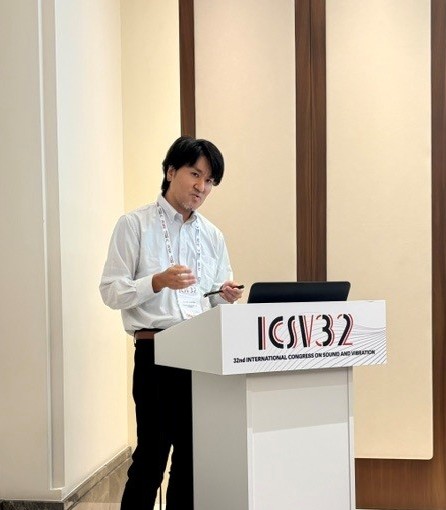
by Takumi Asakura
His presentation introduced the development of a Japanese Digits-in-Noise (DIN) test—a rapid assessment tool designed to measure functional hearing performance in noisy conditions. Traditional hearing assessments often rely on pure-tone audiometry, which measures hearing thresholds but does not necessarily reflect a person’s ability to understand speech when background noise is present.
The DIN method addresses this gap by asking participants to identify spoken digits presented against a background of noise. By adjusting the signal-to-noise ratio, researchers can determine the speech reception threshold (SRT), which reflects how effectively a listener can understand speech in challenging listening situations. The test takes less than three minutes to complete and evaluates communication-related hearing performance rather than simple audibility.
The Japanese version was developed using recordings of native speakers and follows methodologies already established in several other languages. Validation studies showed that the test produced results consistent with international DIN assessments and demonstrated a moderate correlation with conventional hearing threshold measurements.
What makes this work particularly relevant for healthcare acoustics is its future application. Asakura outlined plans to use the test alongside noise exposure measurements, questionnaires and workplace assessments to evaluate the functional hearing abilities of healthcare workers in real hospital environments. This approach recognises that environmental noise and individual hearing capability together influence communication effectiveness and workplace performance. Both important factors when creating better hospital sound environments.
A Common Message
Although the two presentations focused on different aspects of healthcare acoustics, they converged on the same fundamental message: improving hospital sound environments requires attention to both the environment and the people within it.
Van Wezel’s work demonstrates the importance of involving users directly in acoustic design conversations, while Asakura’s research highlights the value of understanding how healthcare professionals actually hear and communicate in noisy settings. Together, they reinforce a broader trend within healthcare acoustics—moving beyond decibel levels and technical compliance towards a more human-centred understanding of sound and its impact on care, communication, and wellbeing.
For those of us working to improve healthcare environments, that may be one of the most important messages taken home from Istanbul.
More reading on this topic:
Early Morning Insights: Evaluating Sound in Emergency Department Redesign