
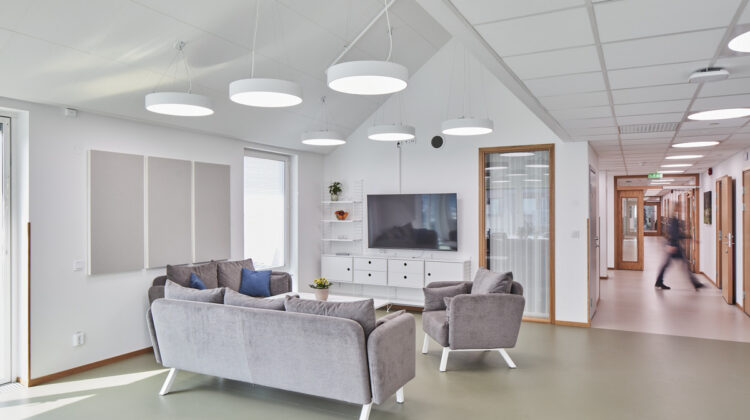
This text was previously published on The Alzheimer Society of Finland’s blog to educate various stakeholders about the importance of a supportive environment for people with memory disorders.
Memory disorder
We know that hearing loss and memory problems are linked: as hearing gets harder, social interactions become more difficult, often causing people to withdraw from them. However, social interaction would provide a much-needed cognitive challenge, which helps maintain memory. A calm sound environment creates better opportunities to participate and stay involved in conversations. For that reason, the sound environment should not be forgotten when designing spaces for the elderly.
Memory and age-friendliness are current topics of discussion in Finland: the proportion of the elderly population will increase in the coming decades, and therefore, the number of people with dementia is likely to increase significantly. Many of these people will live in nursing homes, which are currently being built in large numbers. Thus, now is the time to consider the memory and age-friendliness of the indoor environment from the perspective of someone with dementia.
The sound environment quickly tells us about the space we enter. We register many things: Is the space calm, echoing or noisy? From which direction are sounds coming, and what is happening there? In which direction is it worth paying attention? Hearing and vision typically deteriorate at the same time with age, which can challenge spatial perception. Hearing aids are commonly used, and it should be noted that they amplify both unnecessary and necessary sounds. In addition to weakened senses, memory disorders pose their own challenges to interpreting the environment, often in the early stages of the disease. An echoing space makes it difficult to perceive the direction of the sound source.
A good sound environment makes participation easier
Another important function of the sound environment is to support the activities taking place in the room. Recently in Finland, several initiatives have focused on improving the daily lives and care of people with memory disorders, emphasising the value of participation, interactions, and communication [1]. These activities not only provide essential cognitive challenges but also add meaningful engagement to daily routines. Therefore, communal spaces in nursing homes should be built to encourage conversation and social interaction, making them places where residents genuinely wish to spend time. A well-designed acoustic environment can further facilitate these important encounters.
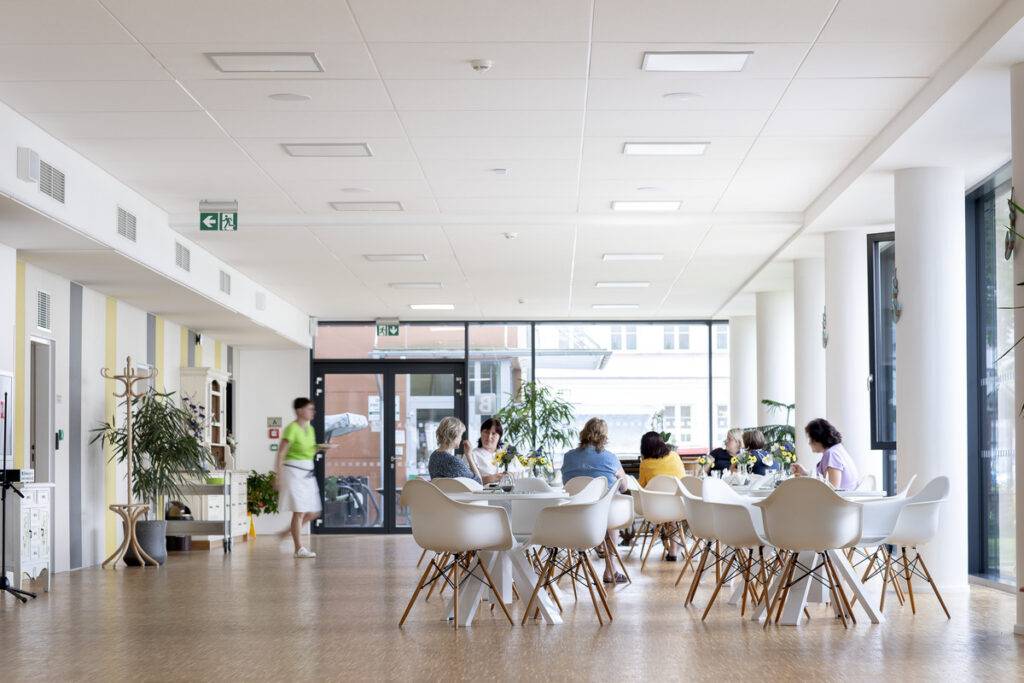
A person with dementia needs a good sound environment to support their communication. It is important to easily understand the conversation partner’s speech, as the ability to complete missing or unheard syllables has declined. If the space is very echoey, speech intelligibility deteriorates, making it difficult to follow the conversation. If mutual conversation becomes tedious, withdrawing from the situation starts to feel tempting. People with dementia are also often sensitive to sound: noise and loud sounds may scare or arouse aggression and increase isolation. A sufficiently calm sound environment can therefore support voluntary participation in important social situations.
“Conversations and social interaction are an important part of memory and age-friendliness. In a suitable sound environment, such encounters are easier when you don’t have to strain to hear and understand your conversation partner.”
Communal spaces and spaces for rest need a calm environment
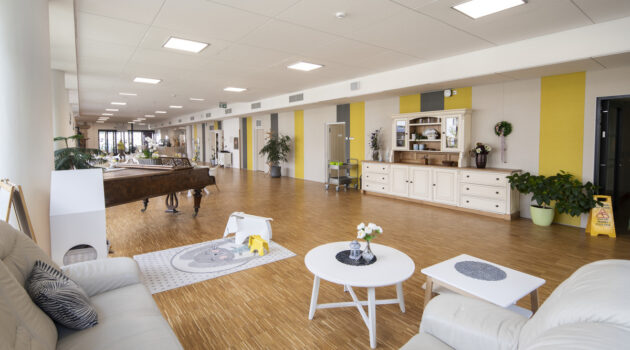
In rooms where people spend time together, it is worth focusing on creating a soft sound environment. When the room has sufficient sound absorption, echoes won’t interfere with speech clarity, and background noise will sound softer.
A space intended for rest should be calm, and sounds from other spaces should not travel through the corridors to disturb rest. Some reverberation can be beneficial in spaces where acoustic music is performed or speeches are given to a larger group.
When a good sound environment is considered at the beginning of the construction project, the best results can be achieved cost-effectively. An acoustic engineer can efficiently design the building’s acoustics.
Material manufacturers usually give good tips as well. Advice on a memory- and age-friendly sound environment can also be found in this guide: Age-friendly and memory-friendly acoustic environments.
Room acoustic improvements in existing buildings
Room acoustics, i.e. the sound environment of a space, can usually be improved in finished spaces. Surface materials affect the sound environment: acoustic panels placed on ceilings and walls can significantly improve it. Acoustic curtains, carpets or soft furniture also have an effect. It is also worth considering functional measures: Are there loud activities or devices in the space, and can they be moved farther away or scheduled for a different time? Is the television on at the same time as you want to have a conversation nearby?
A memory- and age-friendly sound environment is part of accessibility. A calm sound environment supports meaningful everyday life in a nursing home, both in everyday communication and in the perceptibility of the spaces.
[1] https://www.ecophon.com/en/articles/knowledge/new-recommendations-for-the-design-of-age–and-memory-friendly-acoustic-environments/
More reading on this topic:
https://thl.fi/en/research/projects/living-with-dementia-a-social-relational-perspective-to-sustainable-care-soremo-
Author:
Tiia Huuskonen, Concept Developer for Healthcare, Offices and Sustainability at Saint-Gobain Ecophon Finland