Guest post by Professor Marco Caniato University of Applied Science HFT of Stuttgart
After some preparation time, the project began and has been extended due to input from many countries worldwide!
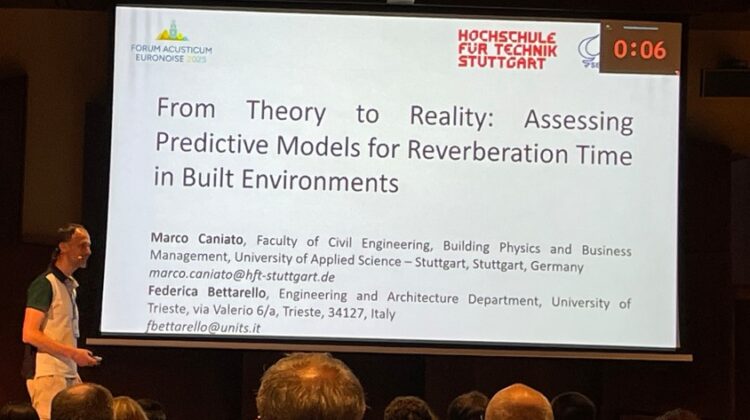
Participants are involved from all over the world, so you are part of a large international scientific research round robin test initiative, bringing together volunteers who generously offer their time to explore a key and fascinating question:
Is the variability of input data a critical issue when applying prediction formulas such as Sabine, Eyring, or those included in ISO 12354‑6?
This is the central aim of the research. Therefore, this Round Robin Test has the sole objective of investigating the variability in the selection of materials and in the calculation of volumes and surface areas carried out by professionals and scientists working in the field of room acoustics.
There is no intention whatsoever to determine who performed best or who most accurately predicted the “correct” reverberation time for a given room.
Provided Material and Task
You are provided with five different environments, for which you are asked to calculate the reverberation time, based exclusively on photographs and vector drawings. Please do not worry: the provided Excel files are already fully prepared and no additional programming is required.
Being aware that your available time may be limited, I have reduced the required effort in order to maximize the quality and comparability of the results. Each Excel file requires only the following input:
- the volume,
- the surface areas,
- the absorption coefficients (α), and
- the source from which each numerical value was obtained.
That is all!
Experimental Design
This experiment is designed to closely resemble real‑life professional practice. When an acoustician must estimate the reverberation time of a room without performing measurements, relying only on drawings and photographs, prediction models (Sabine, Eyring, etc.) and absorption coefficients available in the literature must be used. This situation represents everyday practice for both professional acousticians and researchers.
WHY Five Environments?
You may wonder why five environments are included and why it is important that all five are completed. The reason is that the study aims to evaluate also whether (i) the room volume, and/or (ii) the room function (e.g. classroom, sports hall, canteen, etc.) have an influence on the variability of the predicted results.
HOW will I use of the Results
I guarantee that all results will be fully anonymized, used only in aggregated form, employed exclusively for statistical analysis and scientific purposes. No evaluation will be made regarding the “goodness” or “correctness” of individual contributions, primarily because there is no single correct solution and because such an assessment is not of interest in this study. As explained above, the final objective is to (i) assess the uncertainty (if any) associated with the applied prediction models and (ii) perform an in depth analysis of the sources used for the absorption coefficients.
Therefore, the processed data will be used for a future scientific publication. No commercial use will be made of the results. No participant names will be included anywhere, unless explicitly authorized by you and only in the Acknowledgements section of the publication.
WHAT You Need to Submit
Please send back only the five completed Excel files. Please note that submission of results implies consent to their anonymized scientific use as described above. I do thank you very much for your help.
WHERE to Find the Material
All material is available at the following link:
https://drive.google.com/open?id=18nI2VOkaTjRe1ReOYyfhZylPp3iSiZQT&usp=drive_fs
Each file includes an “Instruction Sheet”. Please read it in advance and follow the instructions strictly. By agreeing to participate in this research, you also agree not to share or distribute the provided materials to any third party.
WHEN: Expected Timeline
The task should require no more than a few hours, although you are of course free to work at your own pace. The Round Robin Test is expected to be concluded within approximately one month. Therefore, I warmly ask you to complete it within the 6th of June.
Very Important: Optional 3D Modelling
If you wish to perform additional calculations—please note: in addition to, not instead of—the Excel based approach—you are more than welcome to do so.
Specifically, you may create a 3D acoustic model of one or more of the five environments, calculate the reverberation time using both: the provided Excel files and a 3D acoustic simulation software.
If you choose this option, please:
duplicate the Excel file corresponding to the selected room, clearly indicate the absorption coefficients used in both approaches, send the calculated reverberation times. For the 3D model, one single result per environment is sufficient.
Inviting other members
Professor Marco Caniato
University of Applied Science HFT of StuttgartSpecial thanks to Arianna Marzi for her work on this.
Previous related post on Acoustic Bulletin: