

Guest post by Carmen Rosas-Pérez (a PhD student at Heriot-Watt University, Edinburgh (UK)).
Sara Ahmed, in ‘Complaint!’ (2021)
Overview
This post summarises the research done for my PhD Thesis ‘Disabling Acoustics: Impact of daily-life acoustic environments on neurodivergent, auraldivergent and noise sensitive people’ carried at Heriot-Watt University (UK) and funded by a James Watt scholarship.

As a neurodivergent acoustic engineer myself, I have experienced and observed how many daily-life acoustic environments can be highly disabling and stressful. During my professional career, I have also noticed how some of the methodologies that we often use in research and practice can exclude and misrepresent diversity in human responses to sounds, leaving out the experiences and perceptual realities that are not always minoritarian and that can be difficult to assess or even identify in laboratory settings.
For these reasons, my PhD research had a focus on exploring the lived experiences of people whose needs are not always considered in spaces designed for a “mythical average”, as Eleine Ostroff highlights in ‘Universal Design: An evolving paradigm’ (2010). In particular, and due to the great importance that the sensory environment can have for us, the three studies carried out in my PhD had the participation of autistic and other neurodivergent people, as well as auraldivergent individuals and people with high noise sensitivity as understood in acoustics research (i.e., not hyperacusis, but a heightened psychophysiological response to sound in the short and long term).
Objectives
The project’s main objectives were:
- To contribute to the understanding of the lived experiences of neurodivergent, auraldivergent and other noise sensitive people in real daily-life acoustic environments, identifying common challenging elements and positive aspects, as well as barriers for changes due to cultural norms and society’s expectations.
- To examine some of the social and scientific consequences related to the lack of human diversity and other epistemic limitations in acoustics and soundscape research and practice.
- To determine strategies and measures to inform guidelines aimed at creating more inclusive and accessible acoustic environments.
The methodologies and the main findings of the three studies included in the thesis are described below.
Study 1: Interviews to autistic people on their lived experiences in real-life acoustic environments
The first study consisted in semi-structured interviews with 12 autistic adults living in the UK, with the aim of providing an in-depth, qualitative outlook to the main challenges and positive aspects experienced due to sounds and acoustical characteristics of common spaces, with five main themes developed during the thematic analysis shown in the diagram below.
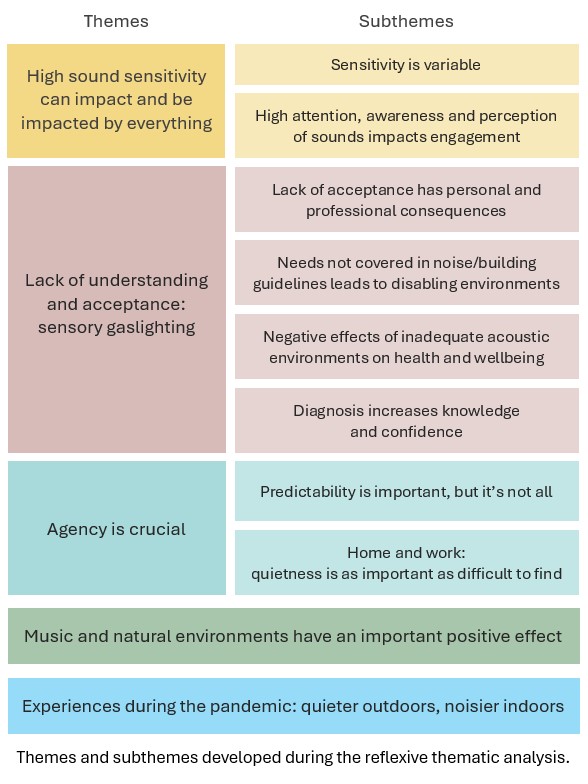
In general, participants’ accounts illustrate in a stark way that the impacts of inadequate acoustic environments, together with constant dismissal of their experiences, result in inequity issues in nearly all aspects of life, including health, education, employment, social relationships, housing, and access to services.
The results of this study, including extracts of the interviews, have been already published (Rosas-Pérez et al., 2025), with experiences specifically related to education and educators (which many participants were or had been) presented in a separate piece (Rosas-Pérez et al., 2023).
Study 2: Survey on experiences of noise sensitivity in daily life
The second study was a mixed-method survey with 311 participants from different countries who considered themselves “noise sensitive” (32% over 45 years old, 59% neurodivergent, and 44% with hearing differences such as hearing loss, tinnitus, hyperacusis or Auditory Processing Disorder (APD)).
The survey included questions related to the most significant factors identified during the interviews.
Key findings are:
- Noise sensitivity was reported to increase with age by two thirds of participants.
- Hearing differences (APD, hyperacusis, tinnitus) were more common among neurodivergent participants; men reported more tinnitus/hearing loss.
- Autistic/neurodivergent participants reported more pain from loud sounds, less habituation, and more difficulty filtering background sounds, among others.
- Coping strategies were more common among neurodivergent participants, including withdrawal, avoidance, alcohol use, quitting jobs, and moving homes.
- Accommodations requests were often denied, and fear of stigma prevented asking for them.
- Preferred interventions included quiet spaces, better insulation, reduced reverberation, access to nature, and working from home.
- Urgent need for improvement in hospitality, public transport, shops, workplaces, education, and healthcare.
The diagram below, lists the most helpful measures that can be used in situations where sound has a negative impact.

Measures to reduce the negative impact of sounds – Replies for “Always” and “Often” by neurodiversity. Percentages calculated with respect to the total number of replies after removing replies indicating “Not needed” and “Never experienced”. ” Autistic group: N=143; Neurodivergent group: N=183; Neurotypical group: N=111.
Study 3: Development and testing of the Acoustical Inclusivity Assessment tool (AcoustInA)
The third study consisted in the development and test of an Acoustical Inclusivity Assessment tool (AcoustInA). The tool was designed to characterise a series of acoustic and non-acoustic aspects in the built environment that can have a significant impact especially in autistic and other noise sensitive people, based on the findings of the other studies. The aim of this tool is to provide information about the space to potential users on one hand, and also to use this information for improvements.
Thirteen collaborators with acoustics expertise evaluated a total of 21 spaces across 6 countries, including airports, offices, hospitals, schools, hospitality venues, shopping centres, and one outdoor playground. The results noted widespread issues such as high sound levels, poor sound insulation, improvable maintenance in equipment, lack of quiet spaces, and limited agency over sounds and/or exposure. Some technological improvements, like acoustic panels and better sound insulation, were proposed by the collaborators, as well as behavioural and informational measures such as clearer signage, feedback mechanisms, and promoting appropriate use of spaces. The test of the tool suggested that it can help integrating subjective experiences and non-acoustic factors in the assessment and improvement of acoustic environments to support health, well-being, and equitable access.
Some take home messages
This work highlights that heightened sensory sensitivity and processing differences, such as the enhanced perceptual capacity that is common in autistic and other neurodivergent people, can lead to experiencing challenges in many daily-life acoustic environments, but that these are often produced and aggravated by inadequate environments, social attitudes and pre-conceptions of what is “normal”. This combination can produce intense, long-lasting repercussions in personal and professional life, health and overall well-being and quality of life. Importantly, the experiences of the participants in the interviews and the survey have been influenced by the fact that they were non-normative experiences in their particular contextual sensory normativity, which made them feel and been treated as misfits, with all the personal, social, and professional implications that this can involve.
There is therefore a need for research and guidelines to become more inclusive by accounting for a higher diversity in sound perception. While individual accommodations can be helpful sometimes, they can also increase burdens and stigma, be conditional of having a formal diagnosis and disclosing it, and even just requesting them entail negative repercussions too frequently. The findings of this thesis have relevance for researchers, engineers, designers, and also policy makers, although changes often encounter barriers related to attitudes also influenced by what is considered “normal” or even necessary to “bear”, and that sometimes can be more the result of social expectations rather than of scientific evidence. This research strongly encourages to recognise how cultural barriers and stigma reduce the accessibility of spaces, in order to make progress in the creation (and normalisation) of more inclusive acoustic environments.
There are indeed many actions that can be implemented with solutions and techniques that already exist, acoustically but also socially, to improve people’s experiences and to prevent some of the negative impacts described in the studies. These actions can be life-changing for individuals with heightened sensory sensitivity, while also being potentially beneficial for the whole population.
Project supervisors:
Supervisors: Laurent Galbrun, Mary Stewart and Sarah Payne
References:
Ahmed, S. (2021). Complaint! Duke University Press. https://doi.org/10.1215/9781478022336
Holmes, K. (2018). Mismatch: How inclusion shapes design. The MIT Press.
Ostroff, E. (2010). Universal design: An evolving paradigm. In Universal Design Handbook (pp. 34–42). McGraw-Hill.
Price, M. (2024). Crip Spacetime: Access, Failure, and Accountability in Academic Life. Duke University Press. https://doi.org/10.1215/9781478059370
Rosas-Pérez, C., Galbrun, L., Payne, S. R., Dickson, A., & Stewart, M. E. (2025). More than noise: Lived experiences of autistic people in real-life acoustic environments. Applied Acoustics, 233, 110581. https://doi.org/10.1016/j.apacoust.2025.110581
Rosas-Pérez, C., Galbrun, L., Stewart, M. E., & Payne, S. R. (2023). How can anyone learn or teach? Experiences of autistic people with sound in schools and universities. Proceedings of Meetings on Acoustics, 51(1), 015001. https://doi.org/10.1121/2.0001741
Publications to date (March 2026):
Rosas-Pérez, C., Galbrun, L., Payne, S. R., Dickson, A., & Stewart, M. E. (2025). More than noise: Lived experiences of autistic people in real-life acoustic environments. Applied Acoustics, 233, 110581. https://doi.org/10.1016/j.apacoust.2025.110581
Masiero, B. S., Caldas-Correia, F., Underwood, S., Rosas-Perez, C. et al. (2025). Ten questions concerning autism and auditory accessibility in buildings. Building and Environment, 113634. https://doi.org/10.1016/j.buildenv.2025.113634
Rosas-Pérez, C., Galbrun, L., Payne, S. R., & Stewart, M. E. (2025). Diversity in sound perception in survey to noise sensitive people and relevance for experimental and field studies. Forum Acusticum Euronoise 2025, Malaga, Spain. https://doi.org/10.61782/fa.2025.0619
Rosas-Pérez, C., Galbrun, L., Stewart, M., & Payne, S. (2024). Experiencias de personas autistas y sensibles al ruido con sonidos y espacios de la vida diaria. Tecniacústica 2024 – Acustica 2024, Faro, Portugal.
Rosas-Pérez, C., Galbrun, L., Stewart, M. E., & Payne, S. R. (2023). How can anyone learn or teach? Experiences of autistic people with sound in schools and universities. Proceedings of Meetings on Acoustics, 51(1), 015001. https://doi.org/10.1121/2.0001741
Rosas-Pérez, C., & Galbrun, L. (2023). Human diversity in acoustics. Towards a more inclusive sound environment. INTER-NOISE and NOISE-CON Congress and Conference Proceedings, 265(1), 6117–6127. https://doi.org/10.3397/IN_2022_0912
Rosas-Pérez, C. (2022). Ears turned up to 11: Sound perception in autistic people. Aural Diversity Network Workshop 3: Acoustics and Psychoacoustics.
Previous posts featuring Carmen’s work: