
In this guest post, Matteo Pellegrini post doc researcher at University of Ferrara shares his latest research paper looking into students sensory and cognitive responses to their university acoustic and indoor air quality conditions.

Matteo Pellegrini Post doc researcher University of Ferrara, Italy
Study introduction
Indoor Environmental Quality (IEQ) describes the overall quality of an indoor environment across four key domains: thermal quality, indoor air quality (IAQ), acoustic quality, and visual quality. Ensuring good IEQ is crucial particularly in educational settings, where inadequate conditions can hinder teaching quality, students’ learning, and their academic performance.
Traditionally, these domains have been examined independently, but recent research has begun to investigate them jointly. However, studies exploring the combined and cross-modal effects of air quality and acoustics remain limited. This study sought to investigate how these two domains influence university students in terms of both cognitive performance and the perception of soundscape and air quality.
Methodology
In the DTU field labs, 29 university students were exposed to two levels of IAQ representative of good and poor conditions, both plausible in university classrooms, and to listening environments that simulated natural and mechanical ventilation (Quiet, Babble, Birdsongs, Mechanical Ventilation). With respect to IAQ, participants were exposed to two bioeffluents levels represented by CO₂ concentrations of 800 ppm (good IAQ) and 3000 ppm (poor IAQ).
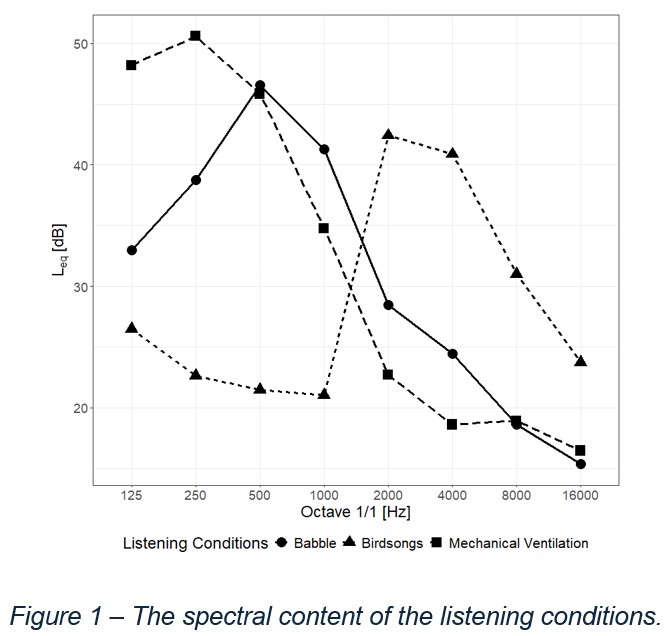
Regarding the acoustic conditions the one selected were not only representative of the environment but, as shown in Figure 1, were also markedly different in spectral content, despite all being presented at the same sound pressure level of 47 dBA. All the sound stimuli were recorded with a binaural headset.
The experimental tasks consisted in a calculation task in which they evaluated whether given equations were true or false, soundscape assessments following ISO/TS 12913-2, and questions regarding their perception of IAQ. Response time and accuracy were collected during the calculation task.
Data were analysed using generalised linear mixed models for the calculation task on both accuracy and response time. Linear mixed models were instead used for the soundscape and IAQ assessments. Soundcape assessments were priorly turned into ISOPleasanteness and ISOeventfulness values as stated in ISO/TS 12913-3
On all the model the influence of IAQ, sound stimuli and their interactions on the outcomes was examined.
Results and discussion
Regarding IAQ perception, results revealed a consistent worsening of perceived air quality across all questionnaire items when students were exposed to the poor IAQ condition. This suggests a possible independence of IAQ perception from the acoustic conditions.
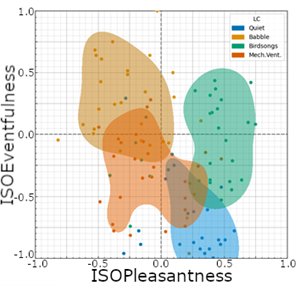
For the soundscape assessments, the auditory stimuli were clearly differentiated within the quadrants of the circumplex model (Figure 2): Quiet was perceived as calm, Babble as chaotic, Birdsongs as pleasant, and Mechanical Ventilation as monotonous. However, no effects of IAQ were observed on soundscape perception. Analogously to perceived IAQ, soundscape assessments therefore appear to be independent of classroom air quality.
Figure 2 – Graphical representation of the combined distributions of ISOPleasantness and ISOEventfulness across all listening conditions (LC).
In contrast to the perceptual assessments, combined effects emerged for the response times in the calculation task. Specifically, only in the Quiet condition was a significant difference observed between good and poor IAQ, with response times being longer under poor (M = 4.54 s) than good air quality (M = 3.74 s). Furthermore, under high bioeffluent exposure, Babble noise led to shorter response times compared with both Quiet and Mechanical Ventilation conditions.
These findings may be explained through the ability of stressors to influence participants’ arousal levels. The relationship between arousal and cognitive performance follows the Yerkes–Dodson law, whereby performance exhibits an inverted U-shaped relationship with arousal. It can be speculated that poor air quality increased arousal levels, which in turn impaired cognitive performance by lengthening response times.
However, it is also plausible that reduced air quality not only elevated arousal but altered the perceived difficulty of the task: poor IAQ may have made the equations feel more challenging, whereas good IAQ rendered them subjectively easier, modifying performance beyond a simple arousal-driven mechanism.
Figure 3 provides an illustrative example of how the two domains may have interacted: under goo IAQ, listening conditions may fall within the “flat” region of the curve, leading to no significant differences between sound stimuli. In contrast, under high bioeffluent conditions, differences in the effects of sound emerge due to the stronger expression of the inverted U-shaped curve.
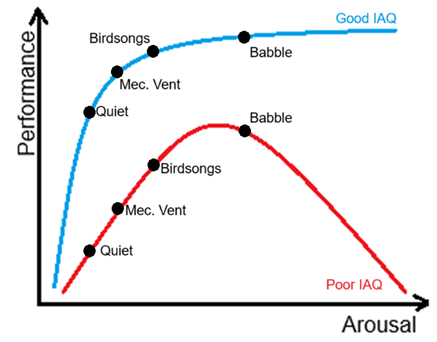
Figure 3 – Illustrative example of the possible interaction between IAQ and acoustic conditions. Good IAQ is indicated by the blue line, while high Poor IAQ by the red line.
Conclusions
These findings offer an initial framework for analysing IAQ and acoustics jointly in educational environments. They tentatively suggest that, when air quality is compromised, natural ventilation may outperform mechanical systems by supporting cognitive performance—as indicated by shorter response times—and by creating more dynamic environments. However, this interpretation remains speculative. Future research should incorporate broader manipulations of IAQ and acoustic conditions, accompanied by subjective and physiological measures of arousal, to further validate and extend these conclusions.
About the lead author and paper
Matteo is a post-doctoral researcher at the University of Ferrara. The work you have read is part of his doctoral project, which aimed to determine the combined and cross-modal effects of acoustics and air quality on students.
The full collaborative study authors
- Department of Engineering, University of Ferrara, Via G. Saragat,1 – 44122, Ferrara, Italy
- Department of Civil, Environmental and Mechanical Engineering, University of Trento, Via Mesiano, 77 – 38123 Trento, Italy
- Institute for Renewable Energy, Eurac Research, Via A. Volta 13/A – 39100, Bolzano, Italy International Centre for Indoor Environment and Energy, Department of Environmental and Resource Engineering, Technical University of Denmark (DTU SUSTAIN), 2800 Kgs. Lyngby, Denmark
Link to the publication here
For additional information, please contact Matteo Pellegatti
Or you can view his profile on LinkedIn here