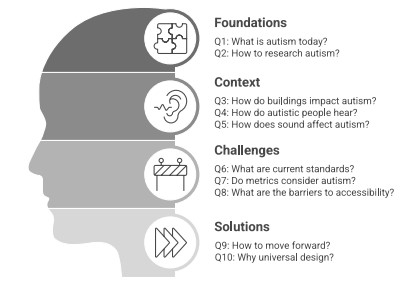
“Ten questions concerning autism and auditory accessibility in buildings” is a recent paper which takes a deep dive into the topic
The comprehensive literature study “Ten questions concerning autism and auditory accessibility in buildings” examines how autistic individuals experience sound within the built environment. The overview highlights major shortcomings in current design standards and offers guidance for more inclusive acoustic practice.
Autistic people frequently exhibit hyper‑ or hyposensitivity to sensory input, with hearing often being the most impactful modality. These sensory differences can make everyday indoor environments overwhelming, especially when auditory conditions are unpredictable or difficult to control.
Key aspects distressing individuals with auditory sensitivity
Across the literature reviewed, autistic individuals consistently identify specific auditory stimuli as major sources of distress, including:
- Sudden, unpredictable noises (e.g., bangs, alarms, impulsive anthropogenic sounds).
- Continuous low frequency noise build up from ambient sound; occupant speech communication activities, occupant movement, HVAC systems, or building services and external noise issues.
- Background noise that interferes with speech intelligibility, contributing to cognitive overload and stress.
- In addition to long reverberation, poor speech clarity (C50), and low definition (D50) are consistently identified as factors that negatively impact autistic individuals in indoor environments, as well as other people with auditory differences
These factors often impair concentration, autonomy, comfort, and social participation, and can trigger heightened physiological stress responses in autistic people during demanding tasks.
Other key Indoor Environmental Qualities (IEQs) which need to be considered
In addition to sound and noise aspects, the study also identifies a broad range of indoor environmental factors that consistently worsen sensory load. These include visually overstimulating settings (glare, flicker), thermal discomfort, strong odours, and complex spatial layouts. All of which interact with acoustic sensitivity and can amplify auditory distress.
Summary and integration with Universal Design approaches is required
Overall, the paper concludes that current acoustic standards—based on neurotypical hearing models — fail to account for autistic auditory processing differences. More flexible, low‑stimulus, user‑controlled acoustic environments, alongside universal design principles and participatory approaches. All are essential to reduce distress and improve accessibility for autistic and other auditory‑sensitive individuals.
Full paper and the relevant authors and acknowledgements:
The full paper “Ten questions concerning autism and auditory accessibility in buildings” is available here.
CRediT the international team of authors and contributors for this extensive study include; Bruno S. Masiero, Fernanda Caldas-Correia, Samuel H. Underwood, Carmen Rosas-Pérez, Alaa Algargoosh, Federica Bettarello, Marco Caniato, William J. Davies, David Manley, Anna Remington, Anjana Sivakumar, Wayne J. Wilson, Luca Zaniboni and Lily M. Wang.
Acknowledgement – The authors acknowledge the Workshop on “Auditory Accessibility and Autism,” which led to the first draft of these 10 questions. Supported by The São Paulo Research Foundation (FAPESP), Brazil [grant number 2022/13570-9]. The authors also acknowledge the University of Nebraska–Lincoln Durham School of Architectural Engineering and Construction. Who covered the gold open access fees for this paper.