
“Acoustics for learning environments across physical and virtual realities” Chaired by Jenina Fels & Arianna Astolfi
After the opportunity to view the interesting poster session in Gratz the learning environments session continued…
Arianna Astolfi – Reality versus Virtual Speech Intelligibility in a lecture room
When field assessments are not feasible, virtual reality (VR) provides a valuable alternative for controlled lab- based subjective evaluations. The study aim was to perceptually validate VR systems for this type of application, previously assessed using objective measures.
A key conclusion from Arianna about this university lecture room pilot. These speech intelligibility room tests, followed by the VR comparison after, can be regarded as perceptually close enough to the real lecture room.
The Politecnico di Torino pilot study also raised an interesting discussion – Around what the just noticeable difference (JND) is when listening through headphones, 3dB?
Jukka Keränen – Spatial decay of speech has an important role in open and enclosed learning spaces
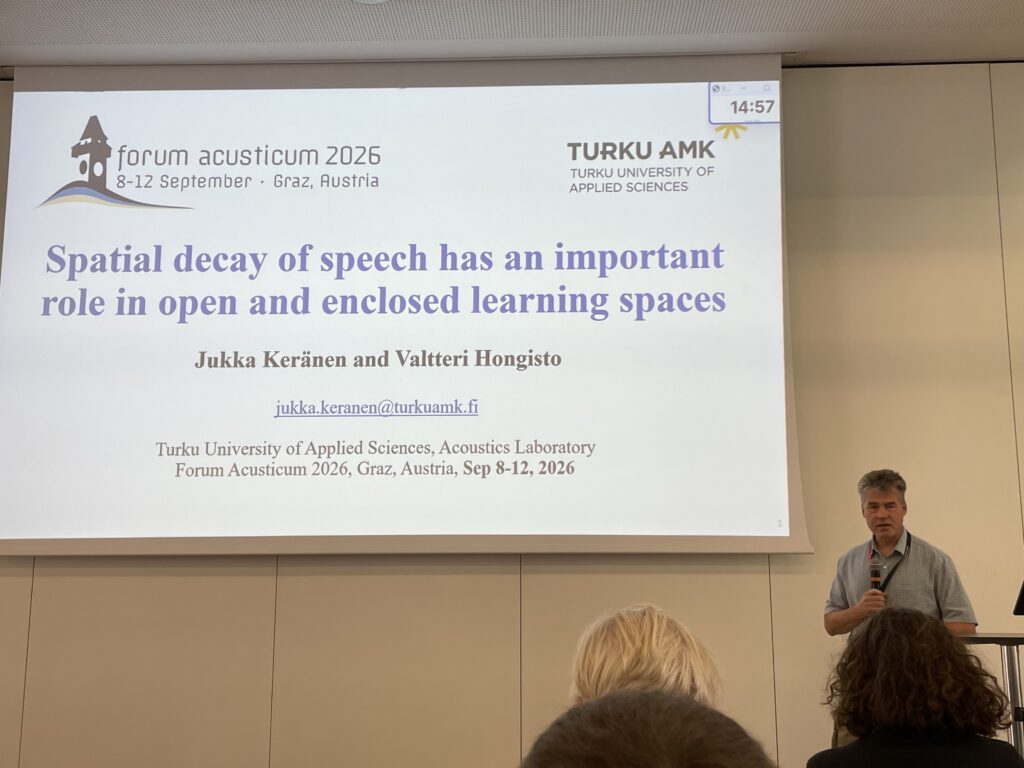
This study looked at the very interesting comparison between enclosed learning spaces vs Open Learning spaces in the context of ISO 3382-3. Evaluating unoccupied spaces with objective measures for spatial decay of speech according to ISO 3382-3 applied in open offices.
The findings suggest that the measurement of spatial decay is justified in both learning space types. This is because it reveals how Speech Intelligibility (STI) behaves at different distances from the speaker.
More about this study here Room Acoustic Differences Between Enclosed and Open Learning Spaces
by Jukka Keränen,Valtteri Hongisto and Jenni Radun
Viveka Lyberg Åhlander – The relationship between listening effort and speakers’ comfort in quiet and noisy teaching environment: an experimental study
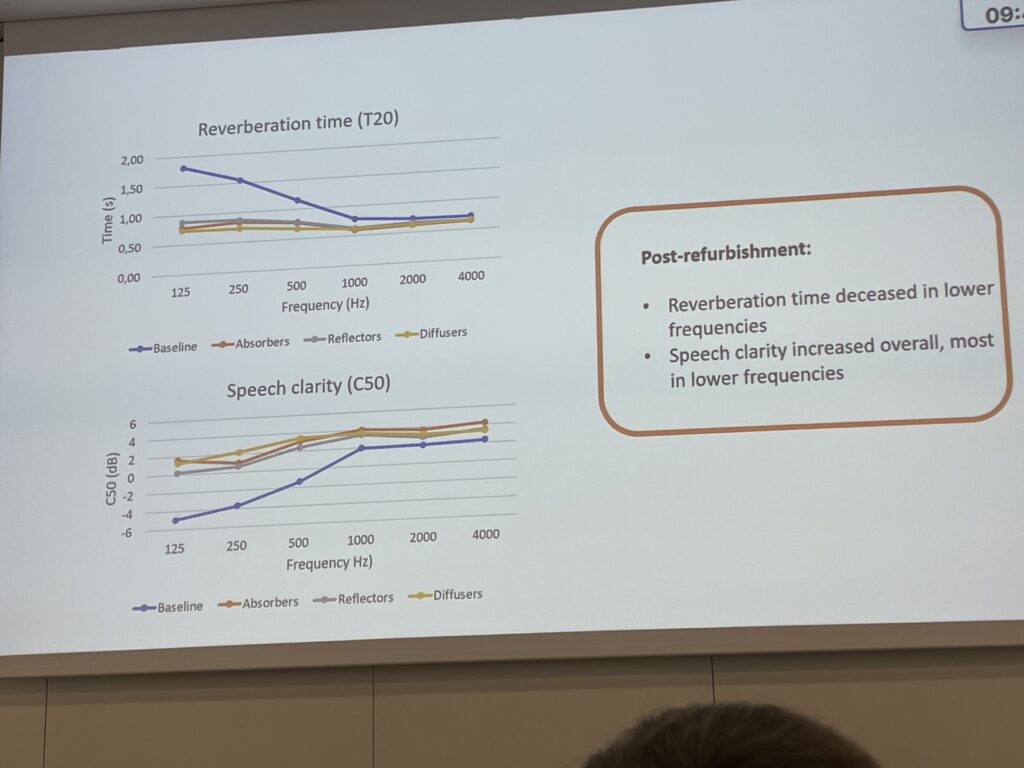
After the acoustic intervention the reverberation time (T20) was decreased in the lower frequencies. There was a general increase in speech clarity (C50). However, the same behaviour was evident in the lower frequencies showing the most significant increase.
Listener comfort and speaker comfort correlated when the room was quiet. Listening effort was reduced with acoustic diffusers and speaker comfort increased with feedback reflectors for speaker feedback in a fixed position. Sound field systems (SFS )reduced listener effort, however, only in good room acoustic conditions.
Insights
In addition to room acoustics, Viveka highlighted another key factor for listeners. Gauging listener motivation can be missed, for example; their sleep quality and general well-being.
Viveka Lyberg Åhlander – Effects of room acoustics and background noise on vocal behaviour in speakers with and without voice problems
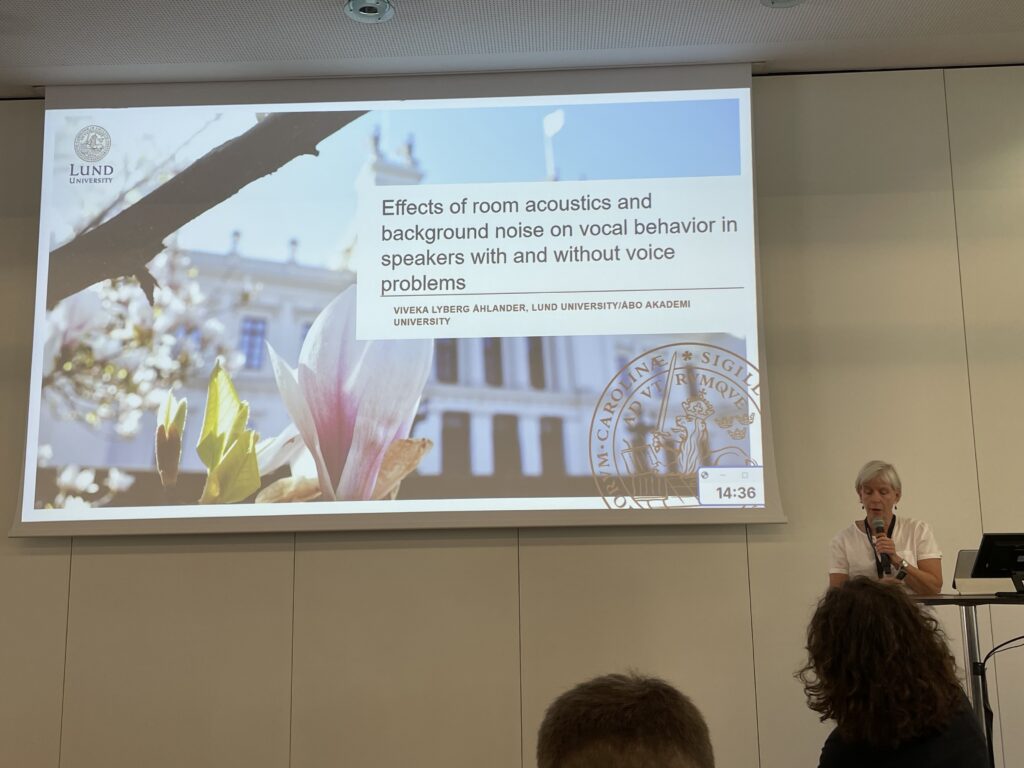
This was an applied laboratory study into the effects of room acoustics and background noise on vocal behaviour. Where three levels of background babble noise (28, 65 & 75dB) were tested in the same room acoustic conditions.
Insights
The acoustic treatment benefits were only seen when the room is quiet – leading to learnings about the theoretical set-up which lacked a behavioural effect which would be expected in reality, a room with good acoustic treatment.
More info about these presentations at Forum Acusticum 2026 conference proceedings.
Previous Acoustic posts and studies by the above speakers: