
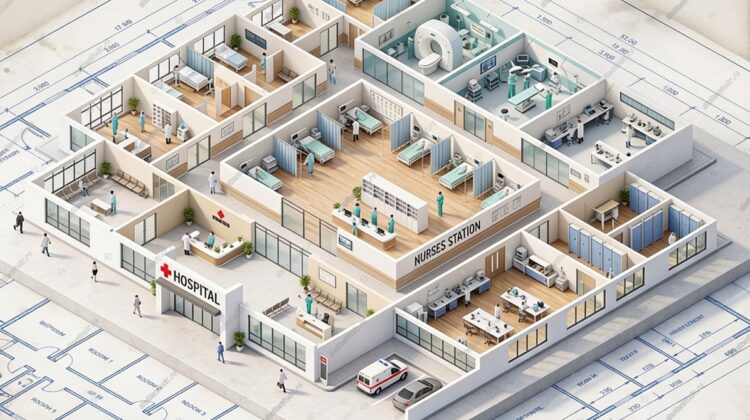
One of the most thought-provoking sessions I attended at Forum Acusticum 2026 in Graz was Session A16.09: Acoustic Comfort in Hospitals. Two presentations approached a similar question from different angles: what actually makes sound annoying in healthcare environments? While researchers have studied hospital noise for decades, both speakers challenged the idea that measuring sound levels alone is enough to understand how patients and staff experience their acoustic surroundings.
Different departments, different soundscapes
The first presentation, Soundscape Quality Across Hospital Departments: Psychoacoustics and ISO 12913 Assessment, by Pasupathan Chithra Barani, explored how sound is perceived in four different hospital departments: Emergency, Intensive Care Unit (ICU), Oncology, and Haematology. Rather than focusing only on sound pressure levels, the researchers combined psychoacoustic measurements with soundscape assessments based on the ISO 12913 framework.
What struck me most was a finding that many healthcare professionals intuitively recognise – two spaces can measure almost exactly the same noise level but feel completely different to be in. The study found that the ICU and Oncology departments had virtually identical average sound levels, yet their perceived acoustic quality differed substantially. The ICU environment contained more alarm-related sounds and exhibited higher roughness, resulting in a harsher listening experience despite similar decibel values.
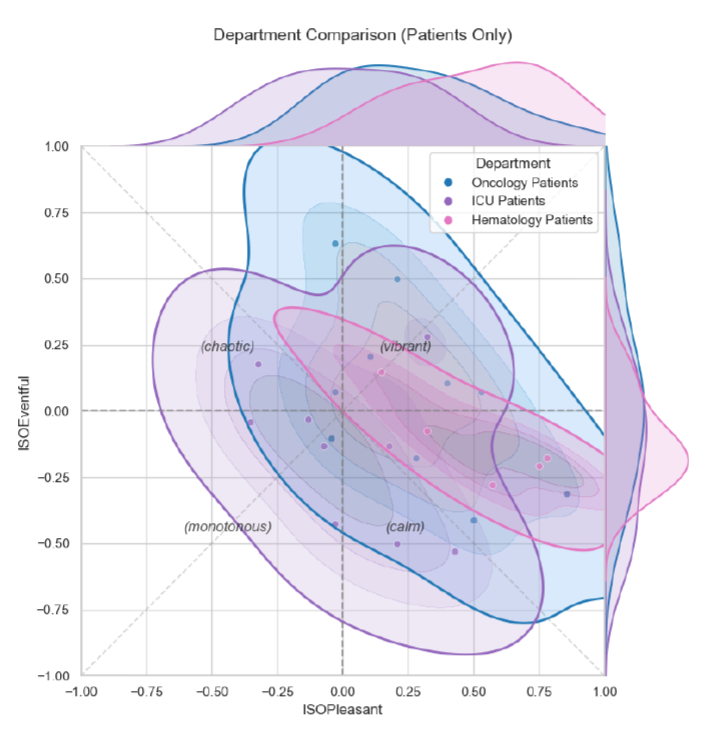
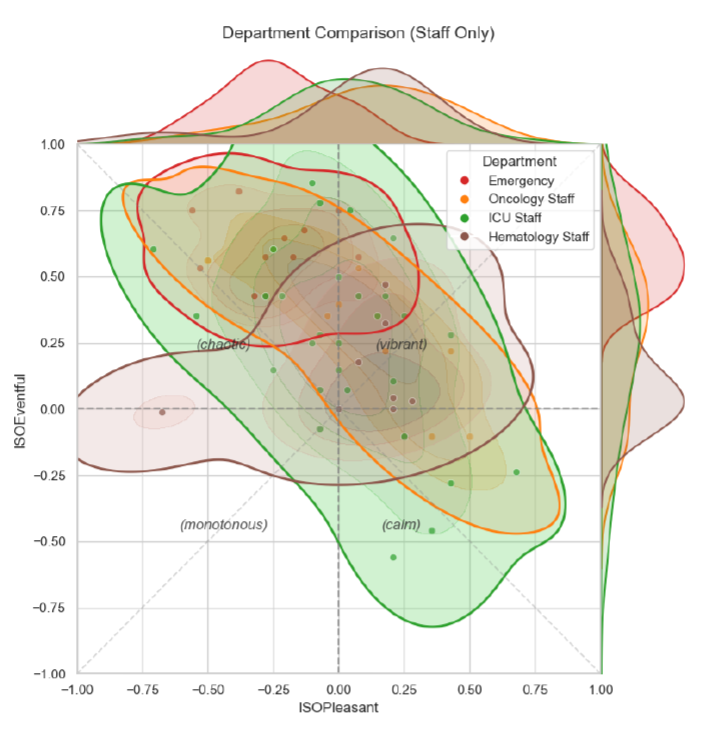
The Emergency Department emerged as the most demanding acoustic environment. It showed the highest psychoacoustic annoyance and the lowest perceived sound quality, while Hematology presented the calmest and most appropriate soundscape. Importantly, the research demonstrated that psychoacoustic annoyance correlated with how “eventful” people perceived an environment to be, while roughness and loudness were linked to lower pleasantness ratings.
A particularly interesting aspect was the difference between staff and patients. In the ICU, staff and patients evaluated the same acoustic environment differently. This highlights a recurring challenge in healthcare design: sounds that are meaningful and necessary for staff may be experienced as intrusive or stressful by patients.
Can annoyance be predicted without recording conversations?
The next presentation, Noise Assessment in Healthcare Facilities: A Preliminary Approach for Estimating Annoyance Based on Source Intrusiveness, by Domenico De Salvio, addressed a practical challenge that many hospital researchers face.
Psychoacoustic assessment often requires audio recordings, but recording sound in healthcare settings raises obvious privacy concerns. The research team from the University of Bologna proposed an alternative approach that estimates perceived annoyance without storing or analysing speech recordings.
They started with the concept of intrusiveness, which can be measured using privacy-compliant sound level monitoring. However, traditional intrusiveness assessments mainly focus on how much a sound stands out energetically from the background. They do not fully account for characteristics that are known to influence annoyance, such as tonal qualities or fluctuations in sound over time.
To bridge this gap, the researchers developed a data-driven methodology to create a weighted Intrusiveness Index. By analysing temporal variations and spectral features from sound-level data, the model attempts to approximate psychoacoustic annoyance without requiring access to the actual audio signal. The ambition is to provide a scalable, privacy-compliant tool that supports healthcare acoustic design and assessment while respecting patient confidentiality.
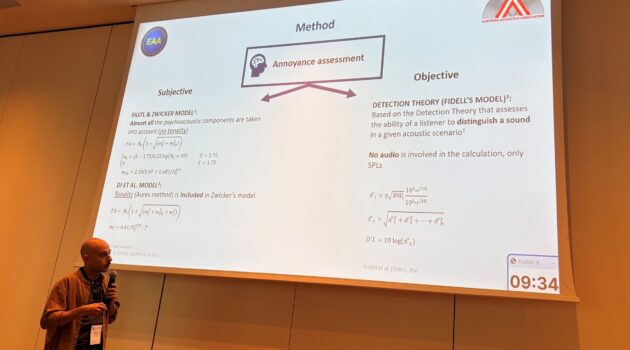
Although presented as preliminary work, it raised an important question for future hospital acoustics research: can we reliably estimate how people experience sound without recording everything they hear?
A common message: not all noise is equal
Listening to both presentations, a clear theme emerged. The discussion is increasingly moving away from the traditional question of how loud it is toward a more nuanced one: what kinds of sounds are present, and how are they experienced?
The Dutch study demonstrated that similar decibel levels can conceal substantial differences in perceived quality and annoyance. The Italian research approached the same challenge from a methodological perspective, seeking practical ways to predict annoyance while overcoming privacy limitations.
Both presentations highlighted the importance of sound characteristics such as alarms, speech, fluctuation and tonal content. In other words, the nature of the sound matters just as much as its level. This is particularly relevant for healthcare environments, where sounds are rarely random. Alarms, conversations, equipment noise and building services all carry different meanings depending on who is listening. A nurse may interpret an alarm as useful information, while a patient trying to sleep may experience the same sound as highly disruptive.
Implications for healthcare design
For those working with healthcare environments, the take-home message was encouraging. Improving acoustic comfort is not simply about making hospitals quieter. It is about creating environments where the right sounds are heard by the right people at the right time.
The research presented in Graz reinforces the need for a more sophisticated approach to acoustic assessment. Whether through soundscape evaluation, psychoacoustic metrics or new intrusiveness-based methods, the focus is increasingly shifting towards human perception rather than sound levels alone.

- Pasupathan Chithra Barani, Faculty of Civil Engineering and Geosciences, Delft University of Technology, The Netherlands. Soundscape quality across hospital departments: Psychoacoustics and ISO 12913 assessment.
- Domenico De Salvio, University of Bologna, Italy. Noise assessment in healthcare facilities: a preliminary approach for estimating annoyance based on source intrusiveness.