
A guest post by Chiara Visentin, a researcher at the University of Ferrara, Italy
Moving beyond noise control towards a child-centred approach to classroom soundscapes
When we think about good classroom acoustics, we often think about reducing noise, controlling reverberation and making the teacher’s voice easier to understand. All these aspects are essential. But are they enough to describe a good acoustic environment from a child’s point of view? This is the question behind SOUNDkids – Indoor SOUNDscape assessment for KIDS in primary school classrooms, a three-year research project developed by the University of Ferrara and the University of Trento and supported by the HEAD-Genuit Foundation.
SOUNDkids starts from the idea that children are not passive receivers of classroom noise. They are active agents that listen to, interpret and react to the sounds around them. Their experience depends not only on how loud a classroom is, but also on what they are doing, what those sounds mean to them and how the environment makes them feel.
The project therefore explores classroom acoustics through a soundscape approach with the longer-term ambition to support the design of learning environments in which acoustic conditions respond more directly to children’s needs, perceptions and well-being.
Why do we need a child-centred approach?
Soundscape research considers the acoustic environment as it is perceived and understood by people in context. Yet, most of the methods used to assess how people perceive sounds around them have been developed for adults. This becomes particularly important in primary schools because children differ from adults in terms of their linguistic, cognitive and emotional development. The words and scales used in adult questionnaires may therefore not capture how a six- or ten-year-old experiences a classroom.
A systematic review conducted within SOUNDkids examined the available evidence on children aged 6–12 (Visentin et al., 2026). It identified 32 studies and showed a highly fragmented research landscape. Many assessment tools were adapted from adult frameworks. Most previous studies also focused on negative effects and impaired performance, while positive and restorative aspects of sound received much less attention.
The review highlighted another important point: physical acoustic indicators alone cannot fully explain children’s evaluations. Perception is also influenced by non-acoustic factors, such as classroom activity, pedagogical organisation and spatial configuration.
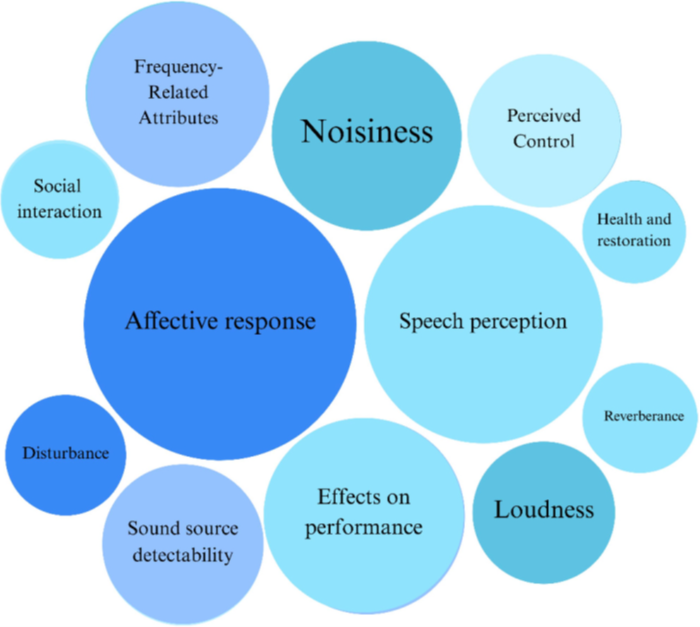
Figure 1. Perceptual attributes used in previous research on children’s classroom acoustic environments, grouped into 12 macro-categories. Bubble size indicates their relative prominence in the reviewed literature. Source: Visentin, Syed, & Torresin (2026).
Listening to children
The next step was to ask children directly (Syed et al., 2026a). Focus groups were conducted with 22 primary school pupils aged 6–12. Children were asked to describe the sounds they encounter at school, explain how they perceive them and talk about how those sounds make them feel. Their responses went beyond the distinction between “quiet” and “noisy”.
Children mentioned indoor and outdoor sound sources, described classrooms as peaceful or chaotic, linked sounds to emotional and bodily responses. Importantly, children described themselves as active participants in their acoustic environment, reporting that they adapt their own behaviour when acoustic conditions become uncomfortable. The analysis led to a conceptual framework that extends the soundscape framework by incorporating children’s own experiences and perspectives.
Beyond “quieter is better”
These first phases of SOUNDkids show that good classroom acoustics cannot always be reduced to achieving the lowest possible sound level. Children tend to prefer environments that are quiet, but not necessarily completely silent. For designers, this suggests a shift in perspective. The key question may not only be: “How can we make this classroom quieter?” but also “What kind of sound environment supports the children and the activity taking place here?”
Turning children’s words into an assessment tool
These findings were then used to develop a child-centred questionnaire, combining the attributes that children use to describe the sound environment with a pictorial scale based on verbal descriptors, visual anchors and illustrated characters (Syed et al., 2026b). The aim is to make acoustic perception easier to express across the 6–12 age range, building the assessment around children’s own language and experience.
What comes next for SOUNDkids?
The next phases of SOUNDkids will use the pictorial tool to investigate the perceptual dimensions underlying children’s evaluations. In this phase children’s perception will be also related to acoustic (e.g., reverberation time) and psychoacoustic (e.g., loudness) indicators, as well as with other children-related (e.g., cognitive skills) and contextual factors (e.g., type of learning activity). Primary school children will use the tool to evaluate ecologically valid acoustic scenarios obtained from binaural recordings of real classrooms during different activities. This experimental phase will allow the researchers to investigate the underlying perceptual dimensions of primary-school classroom soundscapes, with the aim of developing a child-centred model of acoustic perception. The longer-term goal is to connect what can be measured in a classroom with how that classroom is experienced by children, ultimately providing knowledge that can inform acoustic design decisions.
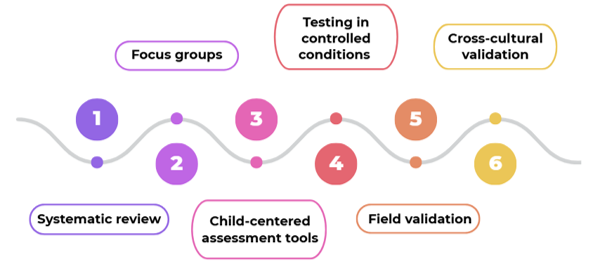
Figure 2. Main phases of the SOUNDkids project, from evidence review and children’s involvement to the development, testing and validation of child-centred soundscape assessment tools.
About the SOUNDkids project
SOUNDkids – Indoor SOUNDscape assessment for KIDS in primary school classrooms is a three-year research project led by Chiara Visentin (University of Ferrara) and Simone Torresin (University of Trento), with Shomaila Fatima Syed conducting the research as a PhD student and research contributions from Jessica Massonnié (University of Portsmouth). The project is supported by HEAD-Genuit-Stiftung (Project P-23/05-W).
Further reading
Visentin, C., Syed, S., & Torresin, S. (2026). Towards a child-centred perspective on classroom acoustics: A systematic review of perceptual attributes, methods and contextual drivers. Applied Acoustics, 254, 111471.
Syed, S. F., Torresin, S., & Visentin, C. (2026a). Investigating perception of children in primary school classrooms: A thematic analysis. In Proceedings of Forum Acusticum 2026.
Syed, S. F., Torresin, S., Massonnié, J., & Visentin, C. (2026b). Children’s acoustic perception of soundscapes in primary school classrooms: Development of a pictorial scale. In Proceedings of Forum Acusticum 2026. Visentin, C., Torresin, S., Pellegatti, M., & Prodi, N. (2023). Indoor soundscape in primary school classrooms. The Journal of the Acoustical Society of America, 154(3), 1813–1826.